close
Get Started Today

Please fill out the form below and a member of our
team will be in touch with you soon.

    PM+M announces nine promotions across the firm

    PM+M, the chartered accountancy, business advisory and financial planning group, has promoted nine colleagues in its latest round of promotions, reflecting the firm’s continued investment in its people and future growth.

    In the Cloud team, Dylan Fraser-Kelly has been promoted to Manager; Anya Holden is now a Supervisor; and Sophie Sandiford steps into the role of Adviser. In the Accounts team, Dylan Brogden has been promoted to Junior Adviser; whilst Hugo Castle becomes a Supervisor.

    In Audit, Jack Groundwater and Harry Yates have both been promoted to Senior Adviser. Rebecca Cowell has been promoted to Senior Credit Controller in Finance; and Georgia Flatley moves into the role of Executive in the Marketing and Business Development team.

    Helen Clayton, managing at PM+M, said: “These promotions are thoroughly deserved and recognise strong technical ability, the significant impact that each person has on our clients and their teams, and the importance they each place on their own continual development. Our over-riding strategy is to remain an independently owned business at PM+M, and as such we are committed to supporting our people to grow by creating clear progression opportunities.  It’s fantastic to see so much talent growing from within.

    Helen added: “I’d like to congratulate everyone on their successes, and I am excited to see them continue to thrive in their new roles.”

    Market update: what’s happening and what it means for you

    As the summer months rolled in, global financial markets seemed to take a breather from the drama of trade tensions and political headlines. Instead, investors shifted their focus back to the basics: how companies are performing, how economies are growing, and the ongoing excitement around artificial intelligence (AI).

    Economic overview: mixed signals across the globe

    While most regions saw little change in economic growth, the United States raised some eyebrows. A major revision to job data revealed fewer new jobs than previously thought, and economic activity slowed during the summer. This led to increased concern about the health of the US economy.

    The US dollar, which had been weakening throughout 2025, found some stability during the quarter. It even regained some ground against the British pound, which is important for UK investors with exposure to US assets.

    Inflation: a growing concern

    Inflation (how fast prices are rising) is becoming a bigger issue, especially in the UK. We’ve been watching this closely, and now it’s clear that inflation could reach double the Bank of England’s target before the end of the year. That means everyday costs could continue to rise, affecting everything from groceries to housing.

    In the US, inflation is also creeping up. However, many companies are choosing to absorb these higher costs themselves rather than pass them on to consumers, likely due to uncertainty about the economy.

    Bond markets react

    Bond markets, which often signal investor expectations about inflation and interest rates, responded to these concerns. Yields on longer-term bonds rose in many countries, reflecting uncertainty about future inflation. In the UK and US, government spending plans added another layer of complexity.

    In the US, the Federal Reserve (America’s central bank) responded to weaker job numbers by cutting interest rates in September, a move aimed at managing risk and supporting the economy. However, not all Fed officials agreed on the path forward, with some suggesting rates should fall below 3% by year-end.

    Back in the UK, the Bank of England faces a tough balancing act. Inflation is proving stubborn, especially in areas like housing and services, making it harder to decide whether to raise or lower interest rates. This uncertainty caused the UK bond market to shift slightly, as investors tried to make sense of the situation.

    Stock markets: AI and emerging markets shine

    Global stock markets saw a shift in leadership this quarter. The US continued to perform well, driven by enthusiasm around AI and related investments. But it wasn’t the only star.

    China stood out, with its tech sector attracting investors thanks to lower valuations compared to the US. Taiwan and South Korea also delivered strong returns, although India’s stock market lagged behind.

    Closer to home, UK and European markets made gains, especially among larger companies. Japan’s market also picked up, helped by a new trade deal with the US and strong company fundamentals, including widespread share buybacks.

    Looking ahead: what should investors expect?

    The more positive mood over the summer has pushed many stock markets into double-digit returns for the year so far. However, UK investors with overseas holdings may have seen some of those gains reduced due to the weaker pound.

    There’s an interesting contrast between stock and bond markets, especially in the US. While bond investors are worried about slowing economic growth, stock investors remain optimistic, focusing on AI innovation and increased merger and acquisition activity.

    Bond markets often spot trouble before stock markets do, but they can also overreact. In the UK, bond investors are more focused on inflation and how it might be controlled without hurting the economy.

    As we head toward the end of the year, expect more headlines about inflation, interest rates, and economic growth. But remember: not all noise is worth reacting to. Staying focused on long-term goals and maintaining a well-diversified portfolio is often the best approach.

    Get in touch

    If you would like to discuss your investments in more detail, or require tailored advice specific to your situation, please get in touch by emailing financialplanning@pmm.co.uk or by calling 01254 679131.

    The value of investments can fall as well as rise. You may not get back what you invest.

    The information contained within this article is for guidance only and does not constitute advice which should be sought before taking any action or inaction.

    ‘Positive impact’ programme supports 20+ charities with time, resources and expertise — and opens applications for the year ahead

    We will once again be inviting local charities and community organisations to apply for support through its ‘Positive Impact’ programme, as the firm begins a new financial year.

    Now in its second year, Positive Impact is our community support initiative and a central part of its wider Corporate Social Responsibility (CSR) strategy. It provides a mix of practical donations, sponsorship, and volunteering — all designed to help charitable organisations across Lancashire and Greater Manchester deliver their services and grow their reach.

    In the last 12 months, we have supported over 20 organisations – including Blackburn and Darwen Youth Zones, East Lancashire Hospice, Child Action North West, Pendleside Hospice, Prevent Breast Cancer, Lancashire Women, Advocacy Focus, Blackburn with Darwen Age UK, Ashgrove Community Centre and numerous food banks. The team has also clocked up more than 135 hours of volunteering.

    Applications for the next round of Positive Impact support are now open, and we are particularly keen to hear from smaller, grassroots or underrepresented organisations that may not always have access to regular funding or corporate backing. The support will remain wide-ranging and locally focused.

    Tara Maynard, Partner in PM+M’s financial planning team and a member of the Positive Impact committee, said:

    “The first year of Positive Impact has exceeded all expectations. We’ve built meaningful relationships with local charities and seen first-hand the difference that small acts of support — whether through time, resources or collaboration — can make. As we move into our new financial year, we’re excited to continue this work and to hear from even more brilliant community organisations doing great things in our region.”

    Helen Clayton, Managing Partner at PM+M, said: “I have always been proud of how we, as a team at PM+M, have given back to our communities.  Creating the Positive Impact initiative has provided us with additional resources to focus on how and where and why we give back, creating time for people to volunteer alongside the financial contributions, which we have increased too.  I look forward to another year ahead where we can add value to others, helping them to achieve more.”

    Charities and community groups interested in applying for support can email positiveimpact@pmm.co.uk for more information.

    Navigating major life events with financial planning

    During your lifetime, you are likely to face a number of significant milestones, such as marriage, buying a home, or retirement. These milestones can be something to look forward to, but also financially challenging.

    Having a strategy in place for your finances can ensure you’re prepared for any immediate expenses along with the long-term impact on your financial stability.

    Possible Key Life Events

    • Career Changes: Depending on your circumstances, a new job or career change could dramatically impact your income or pensions.
    • Marriage or beginning a family: A wedding itself could be a large expense which requires financial planning for months, or even years, in advance. Subsequently, marriage could then bring a shared income and different living arrangements, whilst starting a family could result in childcare and education costs.
    • Buying a Home: Budgeting for mortgage payments, insurance and ongoing maintenance is extremely important when making this significant financial commitment.
    • Retirement: Approaching retirement requires a solid strategy to ensure your pension and savings support your desired lifestyle.

    With the right guidance, these changes can be managed effectively, ensuring your finances are structured to meet your goals.

    Set your Financial Goals

    When facing life changes, it’s important to distinguish between short-term and long-term financial goals. Short-term goals cover immediate needs, like saving for a house deposit or budgeting for childcare. Long-term goals include saving for retirement, paying off your mortgage, or funding a child’s education.

    Create a Realistic Budget

    Once you’ve decided what your financial goals are, you will then have to consider a realistic budget to allow you to achieve these goals. A cash flow forecast is an excellent tool for this, allowing you to test your objectives and create a financial plan to ensure you have enough money to fund your needs. By modelling a cash flow forecast, you can ensure you are on track to have sufficient funds in place. This provides direction and helps you understand what is required to reach your retirement goals, testing different scenarios to get you there.

    Plan for the Unexpected

    Sometimes no matter how well you plan ahead, life can still be unpredictable. An emergency fund and the certain insurance policies can provide a safety net for your finances and peace of mind.

    Where possible, we suggest that you should have enough savings to cover around three to six months of living expenses, should any unexpected emergencies arise, for example house or car repairs. Without this emergency fund in place, it could make it extremely difficult to handle unexpected financial emergencies and the added worry this would bring.

    Considering taking out relevant insurance policies can also provide some extra protection. Depending on your circumstances, this could include life insurance, health insurance, or home insurance.

    Tax Considerations

    Major life events often come with tax considerations which can impact your finances. This could include buying a house, deciding to start your own business, or planning for your retirement. Understanding the tax implications these events will bring and leveraging any available reliefs can be hugely beneficial.

    Property Considerations

    When purchasing property, stamp duty land tax should be a key consideration. The amount will depend on the value of the property and whether it’s your first or an additional home. Selling property could trigger capital gains tax (CGT), particularly if the property is not your primary residence. Additionally, if you are a first-time buyer using a Lifetime ISA (LISA), you can benefit from a 25% government bonus on savings up to £4,000 per year, which can be used towards purchasing a home valued up to £450,000.

    Family Tax Matters

    Marriage can offer tax benefits, such as the marriage allowance, which allows a lower-earning spouse to transfer part of their personal allowance to their partner. Starting a family also introduces new considerations, including child benefit and tax-free childcare schemes, all of which should be considered as part of your overall plan.

    Retirement

    Retirement brings various tax considerations, especially around pension withdrawals. In the UK, 25% of your pension pot can normally be withdrawn tax-free, but the remainder will then be subject to income tax. Additional retirement income from things like rental properties or investments, also require careful tax planning.

    Estate Planning

    Major life events can increase the importance of thorough estate planning. Inheritance tax (IHT) planning ensures your loved ones benefit from your estate without facing large tax bills. Effectively using gifts, trusts, life cover, certain types of investment and IHT allowances can greatly reduce the burden on your estate.

    Reviewing Pension Options

    Pension contributions are one of the most tax-efficient ways to save for retirement. In the UK, retirement plans include workplace pensions, personal pensions, and the state pension, each with its own rules and tax implications.

    Pensions can also play a valuable role in estate planning, as many pension funds aren’t subject to IHT. It’s important to review your pension beneficiaries and align them with your estate plan to ensure your assets are distributed according to your wishes.

    Creating a Retirement Income Plan

    Retirement planning isn’t just about saving; it’s about how you draw on those savings. A retirement income plan balances different sources of income – pensions, investments, and property – in a tax-efficient manner. You should look at putting a strategy in place to reduce any income tax you would be liable to pay on your pension withdrawals and could consider moving your investments to lower-risk options if preserving capital was an important part of your plan. You should also look at how any of your other assets, such as property, could contribute towards your retirement income.

    Summary

    Big life changes can bring big financial challenges and opportunities. It is vital to be proactive and set clear goals. You should create a realistic budget, plan for the unexpected, and seek expert advice on how to optimise your individual financial circumstances.

    For further information or advice on how you can plan ahead to secure your financial future, contact a member of our financial planning team by emailing financialplanning@pmm.co.uk or call 01254 679131.

    The information contained within this article is purely for information purposes and does not constitute financial advice.


    PM+M launches new charity programme called Positive Impact and puts out call for local organisations to apply

    Blackburn and Bury-based PM+M – the chartered accountancy, business advisory and financial planning group – is launching a brand-new community initiative called Positive Impact that aims to increase the firm’s investment in local projects across East Lancashire and Greater Manchester. Applications from charitable and grassroots organisations are now open and can be made via positiveimpact@pmm.co.uk

    Positive Impact is a dedicated Corporate Social Responsibility project that will build on PM+M’s long-term commitment to helping the communities in which it operates. Over the past few years, the firm has provided direct financial support to – and volunteered at – a raft of organisations including Blackburn Youth Zone, Pendleside Hospice, Bury Hospice, East Lancashire Hospice, Blackburn Foodbank, Bury Porch Boxes, Burnley Clarets in the Community and Children Services in Blackburn, Burnley and Bury.

    This new, more formalised structure, which is led by a group of team members, aims to build on that work, whilst at the same time driving employee involvement and empowering them to help select which charities will receive financial donations, time and expertise.

    Helen Clayton, managing partner at PM+M, said: “We are incredibly excited to launch Positive Impact. The enthusiasm and commitment that all of our team have shown – along with their willingness to get involved – has been fantastic. This programme is a testament to our commitment to not only provide exceptional services to our clients, but also to making a positive difference in the communities where we live and work. By enabling our team, and increasing our investment, we are confident that we can drive meaningful change.”

    Tara Maynard, financial adviser at PM+M and part of the Positive Impact team, added: “We want to support causes that make a real difference in the East Lancashire and Greater Manchester areas as this is where we primarily operate and where most of our team live. We now want to get going so I would encourage any charity that might need our help to get in touch. I am really excited to see what we will achieve over the coming months.”

    PM+M sees turnover rise by 15% to record £10.75m

    We are delighted to announce we have seen our consolidated turnover increase by 15% to £10.75m in its last financial year which ended in March.

    We have also increased our total headcount to 164 after making 37 new team appointments, of which 29 are in newly created roles, since 1st April last year. This figure includes 10 apprentices who joined in September. People development has remained a central pillar of the business with a 25% jump in its dedicated training budget.

    We saw consistent growth across accounting, audit and advisory, cloud accounting, corporate finance, financial planning, payroll, tax and private client teams.

    Over the past 12 months, our firm has appointed Helen Clayton as our new managing partner following the retirement of Jane Parry who was in post for over eight years.

    Other notable achievements included leading on a raft of high-profile deals that were handled by the corporate finance team; winning retained contracts with several major North West companies; being named as a UK top 100 firm in the Accountancy Age 50+50 2023 listing for the sixth year running; the staging of a full events calendar for clients; and retaining Investors in People Gold Accreditation. There have also been two waves of promotions across the whole group at all levels.

    Helen Clayton said: “PM+M’s success is simply down to the talents of our people – they are what stand us apart. We all share the same core aims of cultivating strong, collaborative relationships with our clients and other professionals, all the while working together towards mutual success and growth. We also know that innovation is key, so we are constantly evolving the way we deliver our services by staying adaptable, being relevant and making bold decisions when necessary. We are investing heavily in our infrastructure and technology this year and we are excited for what this will enable.”

    Financial planning considerations for the new tax year

    With the new tax year underway, it could be a perfect time to review your finances and consider how to make the most of your allowances and investments for the year ahead to gain optimum benefit. Below we consider some of the areas where utilising the allowances available could make a huge difference and potentially save you a substantial amount of money.

    ISA Allowance

    The new tax year means a fresh ISA allowance of £20,000. ISAs can provide tax free benefits for your savings and investments, allowing you to benefit from higher returns over the long term. Maximising your allowance early can allow more time for your investments to grow, free from capital gains and income tax.

    Pension Contributions

    Most pension savers can contribute up to £60,000 per annum into their pension, however, advice should always be taken as an individual’s allowance can be restricted to an amount less than £60,000 due to complexities with the rules. Similar to the ISAs, pensions are tax efficient savings vehicles which can be accessed from the minimum pension age. Your pension can be used to invest in various different investments including cash savings, investment portfolios and commercial property.

    Also, if you haven’t utilised your allowance from the previous three years, it is possible to carry it forward and boost your pension pot further, subject to certain criteria.

    Capital gains tax allowance

    From April 6 2024, the capital gains tax allowance was reduced from £6,000 to £3,000 per person. If find yourself in a position where you have maximised both your pension and your ISA allowance, you could consider investing into a General Investment Account and crystallise your gains on an annual basis using your capital gains tax allowance.

    Dividend allowance

    Rather than investing in growth assets, there is the option to invest into income distributing funds. Any dividend received on unwrapped investments can be claimed tax free if it falls within your Dividend Allowance, the allowance fell from £1,000 to £500 on the 6 April 2024.

    Inheritance Tax

    You are able to give up to £3,000 each year completely free of any inheritance tax (IHT) liability, this can be a useful way to reduce a potential inheritance tax bill, as well as helping out your family with a financial gift.

    The tax-free inheritance threshold is £325,000 per person, above which 40% rate of tax is due (subject to other allowances).

    You can gift more should you wish but if you died within seven years of the gift, the recipient could be subject to a large IHT bill. You are also able to carry over your allowance to the following tax year so if you haven’t used any of your allowance during the previous tax year, you could potentially gift up to £6,000 without any tax liability.

    Get in touch

    For further information or advice on how you can plan ahead to make the most of your finances and maximise the tax allowances available to you, contact a member of our financial planning team today to talk through your personal circumstances by emailing financialplanning@pmm.co.uk or call 01254 679131.

    The information contained within this article is purely for information purposes and does not constitute financial advice.

    Celebrating Financial Planning Week

    As part of Financial Planning Week 2024, we take a closer look at the PM+M financial planning team and the types of things they can provide advice on.

    Our financial planning team are here to help you make the most of your money. Headed up by partners, Antony Keen and James McIntyre, the team also consists of a director, three further financial advisers and a wider support team.

    The team works collaboratively with our specialists across the firm within our tax, corporate finance, accountancy and payroll functions to help you and your family plan for the future in a way that best suits you. No matter what your requirements are, our expert team will work closely with you to provide a tailored solution that not only enhances your financial position but provides peace of mind that your hard-earned money is achieving more in every way possible.

    Areas of expertise which the team would typically provide advice on include pensions, investments, tax and estate planning, lifetime cashflow planning, financial protection (life cover and illness cover) and services to court of protection clients.

    Some of the common questions our clients typically ask regarding their finances include:

    • I would like to retire at a certain age, how do I ensure I’m in a financial situation to achieve this?
    • Am I on track financially for my retirement?
    • Will my family and/or businesses be ok if I die or become ill?
    • Are my investments and pension investments appropriate in this economic climate?
    • How can I plan to minimise the Inheritance Tax I pay?
    • How much do I need to sell my business for and retire comfortably?

    Once we have spent time getting to know our clients and understanding their needs and objectives, we can then test different scenarios using our cashflow forecast software to understand the best plan of action for the individual circumstances and objectives.

    The relationships we build with our clients are paramount and we are always here to provide ongoing support and advice as plans can often change during the journey of life.

    Looking after over 300 million pounds worth of assets for our clients, you can be sure our financial planning team is perfectly placed to offer the best advice on looking after and getting the most from your assets. For further information or advice, contact a member of the financial planning team today by emailing enquiries@pmm.co.uk or calling 01254 679131.

    Common myths for financial planning

    The thought of financial planning can be overwhelming and the amount of conflicting advice can leave you feeling lost when it comes to planning ahead to make the most of your financial situation. To help, we explore a number of common myths when it comes to financial planning.

    Myth: Financial planning is only needed if you’re wealthy

    Although it is wise to plan your finances well if you have large amounts of wealth, it can still be hugely valuable even for those with modest wealth. Understanding your financial situation in detail and how to make the most out of it can help you plan in a way that is going to be most beneficial, and investing even a small amount can still provide good returns over time.

    It’s important to be clear of your lifestyle aspirations and then tailor your finances to achieving those goals, this is something your financial planner will be able to help you map out and ensure you’re planning ahead accordingly for the short, medium and longer term.

    At PM+M, once we have spent time getting to know our clients and understanding their needs and objectives, we can then test different scenarios using our cashflow forecast software to understand the best plan of action for the individual circumstances and objectives.

    Myth: I’m too young for retirement planning

    Retirement can be achieved at a variety of ages depending on many different factors, some people are able to retire much earlier than others by working extremely hard and with some extensive financial planning. If this is something you are aiming for, or even if you simply wish to plan ahead to ensure you are going to be comfortable in later life, the sooner you start planning the better!

    In terms of your pension for instance, the earlier you begin saving into your pension, the more time your money has to grow and it is highly likely something you will thank your younger self for in years to come.

    By looking ahead as to what you would like your retirement to look like in an ideal world, you are able to plan what steps you would need to take financially to allow you to achieve this. The more time you have to do this, the more you are able to spread the financial impact across a greater number of years, therefore reducing the impact you are likely to feel on your finances. This would also provide more time to make any necessary changes, should your desired retirement plans change.

    We can use our cashflow forecast software to test different scenarios to help understand the best plan of action for your individual circumstances and objectives.

    Myth: I can only invest if I have large amounts of money

    Obviously the more money you invest, the greater returns you are likely to see, but this does not mean it’s not worth investing smaller amounts of money.

    Whatever the amount, you may want to consider putting your money into medium or long-term investments (five years or more). Unlike savings, investments have more potential to grow over time. You have tax efficient options, for example, an ISA or a pension. A small amount regularly invested each month over a few years can often result in a good return over time, providing a strong investment strategy is in place.

    At PM+M, we offer a bespoke managed portfolio service (in partnership with AJ Bell) which we continually monitor and proactively make fund and asset allocation changes when we feel as though this is necessary. You can find out more about our portfolio service here.

    Myth: The State Pension will be enough for my retirement

    Depending on what you want to achieve from your retirement, you may find that relying on the state pension could leave you drastically short of achieving what you have in mind. The full State Pension is £221.20 per week for the 2024/25 tax year (up from £203.85 in 2023/24), providing you have paid the necessary 35 years National Insurance. This equates to around £11,502 a year which works out much less than you would earn if you were working a full-time job on minimum wage, this comparison helps put the figures into perspective.

    With the ever-rising costs of living, it is certainly worth doing your sums carefully and if you are planning on relying solely on your state pension, that it will enable you to live a lifestyle you are comfortable with in retirement.

    However, the State Pension does provide an invaluable income underpin.

    Get in touch

    For further information or advice on any of the common myths discussed above, contact a member of our financial planning team today to talk through your personal circumstances, email financialplanning@pmm.co.uk or 01254 679131.

    The information contained within this article is purely for information purposes and does not constitute financial advice.

    Are you making the most of your tax allowances?

    Making use of tax allowances is at the cornerstone of all financial planning matters. In the high interest environment, which we currently live in, it has never been more important to ensure that you are maximising all available allowances.

    Personal savings allowance

    At the beginning of the new year the Bank of England base rate remains at a 15 year high of 5.25%. Whilst these high rates are to the delight of savers, many individuals are now being hit with income tax liabilities on interest payments. Depending on your tax status individuals have a personal savings allowance of:

    Basic Rate – £1,000

    Higher Rate – £500

    Additional Rate – £0

    If the interest which you receive exceeds your personal savings allowance the distribution will be taxed at your highest marginal rate of income tax. There are many allowances available to individuals and these are summarised below:

    Personal allowance – Income Tax

    If you are retired and pre-state retirement age, you may be earning less than the personal allowance (currently £12,570). This is your personal income allowance before you start paying income tax. There is the opportunity to draw additional income to utilise that allowance, potentially from your own pension, releasing income without paying income tax.

    ISA Allowance

    Individuals have the option of investing £20,000 per person into an ISA. Savers have the option to deposit funds into a cash ISA, however if you are taking a longer term view you may wish to consider investing into a Stocks and Shares ISA.

    Another consideration could be a Lifetime ISA, perhaps you’re saving a deposit for your first home, but if you aren’t saving that money into a lifetime ISA, you could be missing out on an annual bonus of £1,000 paid for by the government. Although you can only use the money you save to buy a property (below £450,000), if you’re aged 18-39 and haven’t yet bought your first home, you are able to save up to £4,000 a year and you will receive an extra 25% on top!

    Pension annual allowance

    Following on from the spring budget, pension savers can now contribute up to £60,000 per annum into a pension. However, advice should be taken as an individual’s allowance may be restricted to an amount less than £60,000 due to complexities with the rules. Similar to the ISAs, pensions are tax efficient savings vehicles which can be accessed from the minimum pension age. Your pension can be used to invest in various different investments including cash savings, investment portfolios and commercial property.

    Capital gains tax allowance.

    During the tax year 2023/24 the capital gains tax allowance is £6,000 per person. If you have used both your pension and ISA allowance, you could consider investing into a General Investment Account and crystallise your gains on an annual basis. Please note that the capital gains tax allowance is reducing to £3,000 from 6th April 2024.

    Dividend allowance

    Rather than investing in growth assets there is the option to invest into income distributing funds. Any dividend received on unwrapped investments can be claimed tax free if it falls within your £1,000 Dividend Allowance. Please note that the Dividend Allowance will fall to £500 from 6th April 2024.

    GET IN TOUCH

    For further information or advice on how to best utilise your allowances, please contact a member of our financial planning team by emailing financialplanning@pmm.co.uk or call 01254 679131.

    A comment to note that the article does not constitute personalised advice and that advice should be sought before taking any action.

    UK Equities – where are we at?

    2023 has seen UK equities fall behind again in terms of returns and it continues to be widely publicised that the UK equity market has become a global backwater, with companies and investors lacking vibrancy. However, if you look more closely, there remain important features of durability which should continue to keep capital flowing in.

    In terms of positives for the UK, it looks to be in a good place in terms of property rights and rule of law, the political system allows governments and leaders to operate relatively well, the Treasury has a solid track record of collecting taxes, and there are also time-zone and location benefits.

    Why is it important?

    The long-term health of the UK is key when it comes to investment portfolios. When considering the blend of an investment portfolio for UK-based investors and those likely to have liabilities in sterling, investing in the domestic market can often help to reduce currency risk, cost and tax.

    Many assume that companies listed in the UK are priced in pound sterling and therefore are excluded from currency risk, however this is not necessarily the case. Revenues and cost bases are often global in nature and profitability can be dictated by the performance of the pound. Any weakness could be down to a tailwind for those generating revenues in another currency, and the other way round. This could potentially have a serious impact on those with large cost bases in the UK.

    Measuring and managing the translation effect is virtually impossible given the huge number of factors impacting company accounts, and the fact that accounts are only ever a ‘point-in-time’ snapshot of activity provides an extra complication. At least by having a home bias, it provides a degree of reduced currency risk and diversification.

    When it comes to tax, this is essentially about the treaty status between the UK and the country of domicile, where the dividends or interest payments originate. In relation to withholding tax, this is taken at source and dividends coming from US-listed investments, for example, would be levied at 30% for UK investors. This could be reduced by a series of forms and reclaims but can act as a drag on performance for both active and passive investments. Although relatively small given some markets are not focused on dividends, this barrier to return can give the UK market an advantage for UK investors.

    Summary

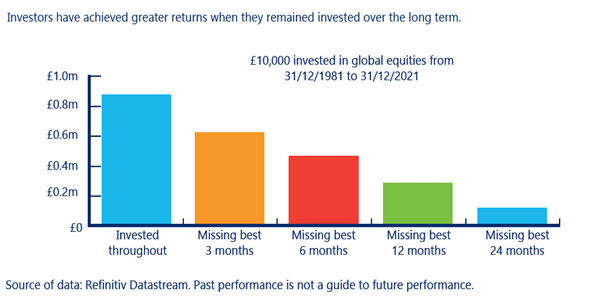
    The nooks of the matter are that we continue to believe in a well-diversified portfolio which helps us manage volatility and medium-long term performance. If we exit from certain equity markets, we miss out on the upturns too. This is depicted in the below graph which highlights the value as at 31/12/21 of a £10,000 investment being placed in 1981, in various scenarios.

    Inflation is high and interest rates have been ascending, but this isn’t just a story for the UK, this is happening all around Europe.

    Get in touch

    As always, every individual situation is different, and it is vital to get advice based on your exact circumstances when considering any type of investment.

    If you would like to discuss your investments in more detail, or need some tailored advice specific to your situation, please get in touch by emailing financialplanning@pmm.co.uk or by calling 01254 679131.

    The value of investments can fall as well as rise. You may not get back what you invest.

    The information contained within this article is for guidance only and does not constitute advice which should be sought before taking any action or inaction.

    Inherited pensions could be taxed under new proposed rules

    From 6 April 2024 inherited pensions may no longer be excluded from marginal rate income tax, following plans announced by the government to change income tax rules for inherited pensions and make them liable for marginal rate income tax.

    It is not yet fully understood exactly how the proposed tax change will work as it was only mentioned as part of new guidance in relation to the removal of the lifetime allowance, so further detail and clarity is needed.

    As part of the Spring Budget 2023, the lifetime allowance cap was abolished which removed tax liability on larger pension pots exceeding £1.07m. During the latest announcements it was stated that the government now intends to charge tax on pension benefits at marginal rates of tax.

    It is believed that the measure is being introduced as a way to offset the loss of tax from the removal of the lifetime allowance. However, as far as we are currently aware, all pension beneficiaries would be included.

    Who will be impacted?

    Under the current regime, if someone dies before age 75, their pension can be inherited completely tax-free if taken as income

    However, the government is considering new rules, where someone dies before age 75 and they choose to access as yet untouched inherited pension as income, the entire amount would be subject to income tax.

    By contrast, if the same person took the inherited pension as a lump sum and it was within the £1,073,100 lump sum limit, it would remain tax-free

    Therefore, these changes could potentially subject many more people to taxation and would affect beneficiaries of members who die before age 75 leaving unused funds in their pension pot.

    Summary

    The proposed changes could be huge for the way tax is treated in relation to beneficiary pensions and further clarity is certainly needed from the government before they come into force from 6 April 2024. However, it could be sensible to plan ahead where possible and think about how the changes might affect your personal circumstances.

    For further information or advice on how the potential changes could impact you, get in touch with a member of our financial planning team by emailing financialplanning@pmm.co.uk or calling 01254 679131.

    A comment to note that the article does not constitute personalised advice and that advice should be sought before taking any action.


    Could you boost your state pension?

    Could you boost your state pension?

    The state pension usually forms a large part of retirement planning, and it is important to check that you have made the necessary national insurance contributions to receive the full amount. If you find you have fallen short, there is the option to ‘top up’ with voluntary contributions but there are restrictions on this.

    The original deadline to plug any missing gaps dating back to 2006 was 31 July 2023, however following the massive number of calls received ahead of the deadline it has now been extended to April 2025. The extension means that individuals will have a longer period to fill any gaps to ensure they will be eligible to receive the full state pension at retirement. Filling in the gaps normally offers great value for money, as the break even point could be around 4 years in to receiving your state pension.

    To qualify for any state pension, you will require a minimum of 10 years national insurance contributions. As of the tax year 2022/23, the full state pension entitlement is £203.85 per week and to qualify for this, a full 35-year national insurance contributions is required.

    Presently state pension age is 66 for both males and females. Current legislation is for state pension age to increase to 67 in 2028, and it is being ratified for an additional increase to age 68 in 2039.

    Summary

    If you think you may fall short of receiving your full state pension because of gaps in your national insurance contributions, looking to top these up with voluntary contributions could be a great way to ensure you’re going to have sufficient funds to live the lifestyle you desire in retirement.

    Along with many other considerations, your state pension should be a key factor in your retirement planning. We can help you plan ahead by creating a personalised cashflow plan which is based upon your current circumstances and an agreed set of assumptions.

    Get in touch

    For further information or advice on your pension savings and planning for your retirement, get in touch with a member of our financial planning team by emailing financialplanning@pmm.co.uk or calling 01254 679131.

    A comment to note that the article does not constitute personalised advice and that advice should be sought before taking any action.  

    Is the new year a good time to consider your investments?

    With a fresh year underway, it could be the perfect time to review your investments and consider if there are any adjustments you should be making given the current challenging financial market.

    With huge amounts of uncertainty due to various reasons including the cost-of-living crisis, recession and the ongoing crisis in Ukraine, it can be tempting to make changes to your investments or look to withdraw them out of fear. However, as the well-known golden rule of investment states, “time in the market beats timing the market!”.

    What should I do?

    Although often difficult, it is important to ride out a negative market cycle where possible. There may be circumstances where access is unavoidably required, but investors must generally hold their nerve and remain focused on the long-term objectives.

    If an investor finds themselves in a phase of accumulation, ongoing investment contributions benefit from market volatility as, when markets fall, investors can often buy more units for their money. Regular investors can benefit from pound cost averaging to potentially smooth out market volatility. Fewer units are purchased when prices are high, but more units when prices are low.

    Investors who find themselves in a decumulation phase (i.e. those who are accessing their portfolio) must be ready to play the waiting game as it is typically better to ride out market cycles rather than try to time them. Those who exit the markets temporarily could find themselves buying back in after markets recover, which can be risky.

    If you are close to, or have reached your de-cumulation phase, you should hold a contingency fund to ensure any capital requirements can be satisfied from cash, rather than risk selling down part of an investment portfolio at a bad time. It is also important to consider retaining cash to provide the liquidity to fuel ongoing income requirements for a set period, reducing the risk of having to sell down for liquidity purposes during periods of volatility.

    Summary

    Investors should remind themselves why they are investing, have a plan in place and bravely ‘ride out’ a difficult market cycle – holding cash for contingency and shorter-term liquidity can help with this.

    Meanwhile, diversification across assets is also important to ensure you have a portfolio capable of withstanding a negative market cycle. This means including assets which are likely to do well during economic growth, but also some that are likely to do better in difficult times. It is usually a good idea to include a broad mix of equities, bonds and some alternatives. It may also be wise to consider a variety of sectors and themes too.

    Get in touch

    As always, every individual situation is different, and it is vital to get advice based on your exact circumstances when considering any type of investment. PM+M’s Managed Portfolio Service, is a bespoke investment portfolio produced by us, and managed in collaboration with AJ Bell, to make your life easier. At PM+M, we are currently having a rethink of our house asset allocation (blend of investments) and will shortly be implementing these changes for our clients as we plan forwards for them.

    If you would like to discuss your investments in more detail, or need some tailored advice specific to your situation, please get in touch by emailing financialplanning@pmm.co.uk or by calling 01254 679131.

    The value of investments can fall as well as rise. You may not get back what you invest.

    The information contained within this article is for guidance only and does not constitute advice which should be sought before taking any action or inaction.

    How to plan financially for a recession

    With forecasts predicting the UK is facing the prospect of a challenging two-year recession, inflation rising at a record rate and the cost of living crisis ever widening, as part of our recession resilience series, we consider some of the ways you can look to prepare financially.

    If possible, save an emergency fund

    During a recession, the risk of redundancy is unfortunately higher and this coupled with factors such as household bills continuing to rise, means it is extremely sensible to have an emergency fund available if at all possible. The ideal would be 6 – 12 months’ worth of expenses but obviously any amount is better than nothing.

    If you are able to raise an emergency fund, it can provide some much-needed peace of mind that you would be able to survive without having to take on additional debts or get in arrears with any bills. It is also important to remember that there can sometimes be unexpected events which arise and require immediate funds at short notice, such as damage to your property or vital car repairs.

    If saving an emergency fund is not an option, which is the case for many right now, then it is always worth looking closely at your everyday expenses to see if there are any savings that can be made there, although these may only be small individually, it can soon add up if there are a few.

    Review your investments

    Considering historical data, we know that stocks tend to rise right into a recession and fall during it. However, it’s impossible to forecast, as both markets and economies are unpredictable.

    It is important to understand that the market can be volatile, and you should aim to focus on the long term. Our Managed Portfolio Service is a bespoke investment portfolio produced by us, and managed in collaboration with AJ Bell, to make your life easier.

    Of course, when a recession is predicted, it is completely normal to worry about your investments. Working together, we continually monitor the market, conducting ongoing due diligence and proactively making fund and asset allocation changes when we feel it is necessary to manage volatility and drive long term growth.

    If you do have spare cash, there could be an opportunity to buy whilst markets are devalued; this could represent good long-term value.

    However, if your cash isn’t available to invest for at least 5 years, it’s worthwhile reviewing bank interest rates to ensure that you are capturing the most efficient return.

    Examine your mortgage

    Look ahead and speak to a mortgage expert before there are changes in your circumstances or any fixed rates come to an end. Unfortunately, it is looking likely for many that a rise in interest rates is inevitably going to lead to higher mortgage payments so it is sensible to start looking now at ways you are potentially going to be able to manage this. It may be necessary to look closely at your monthly expenses so see if there are any possible savings to be made which could cover a rate rise.

    Are you protected?

    Most people’s greatest asset is their income so in uncertain times, it’s more important than ever to make sure you are protected if you were to become unable to work because of illness or injury. Income protection or critical illness cover could provide a vital financial lifeline to you and your family should the worst happen and you become too ill to work.

    Another one to consider could be mortgage life insurance which would provide a lump sum to your family if you were to die prematurely. This could remove the huge burden of having to cover the remainder of the mortgage debt for your family in this difficult situation.

    Think carefully about your pension

    When faced with difficult financial challenges, it could be that your pension is low down on your priority list but this could prove to be a costly mistake in the long run. Your pension provides a great, tax efficient way to save and it is important to protect it, even when cutting back on your contributions could make life easier in other areas.

    If you are getting close to retirement and are concerned that your pension fund may have decreased in value because of the falling stock market then speak to your pension provider, for most, this shouldn’t be a problem as the level of risk for a pension portfolio decreases as you get closer to retirement age.

    If you don’t already have a pension, it could be a good time to consider starting one as if you look to invest while the stock market is low, it can provide more opportunity for higher returns in the longer term.

    Summary

    There is no doubt that the coming months are going to be a huge challenge for many but considering some of the above factors in advance and being pro-active with planning for the worst, could make a huge difference to your financial outlook long term.

    Get in touch

    For further information or advice, contact a member of our financial planning team today to talk through your personal circumstances, email enquiries@pmm.co.uk or call 01254 679131.

    A comment to note that the article does not constitute personalised advice and that advice should be sought before taking any action.