





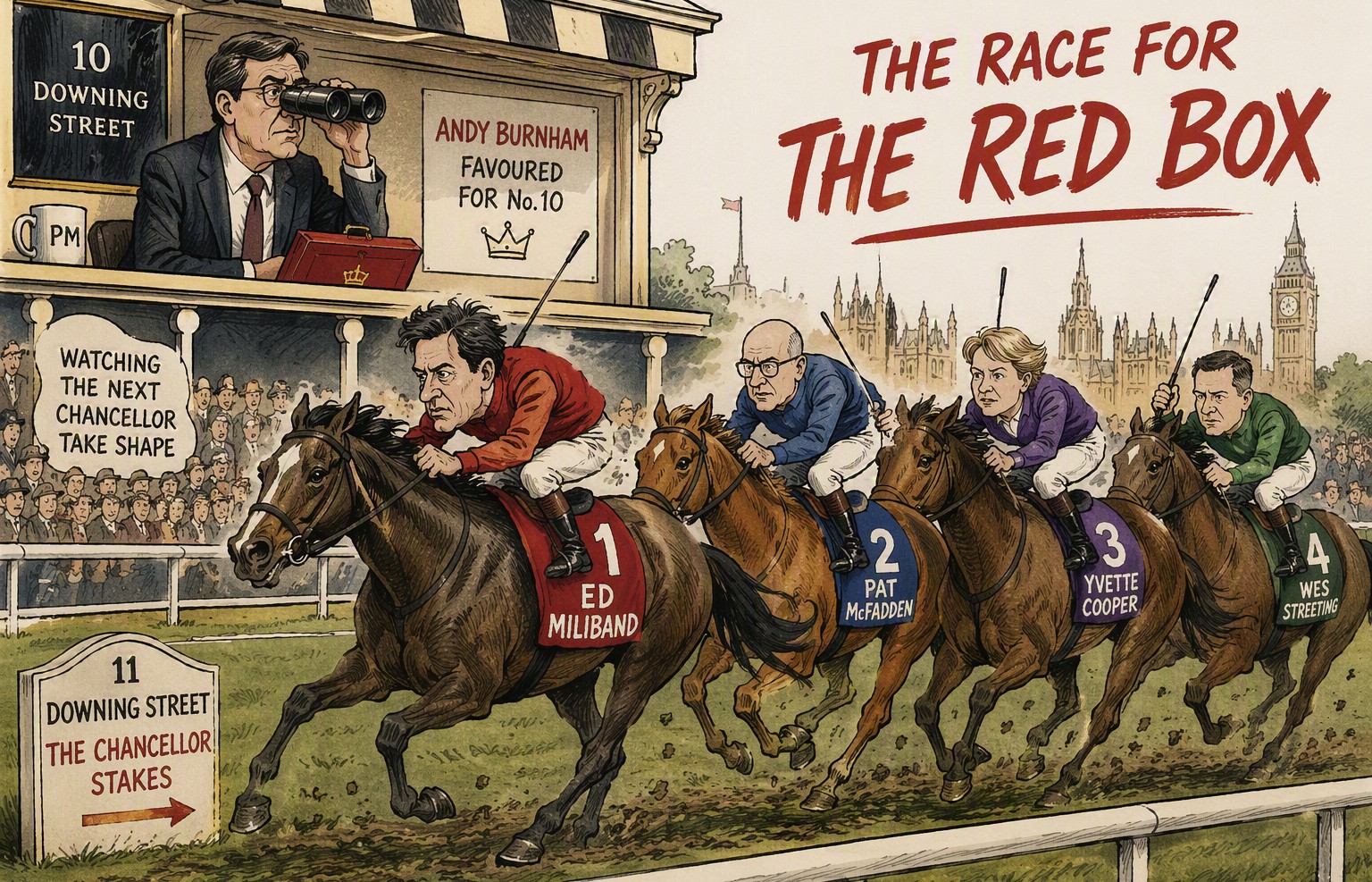
With continuing speculation around Rachel Reeves’ long-term future as Chancellor, bookmakers are already pricing up her potential successors. Whilst political betting markets should always be treated with caution, they do provide an interesting snapshot of Westminster sentiment.
(Un)fortunately, PM+M’s firewall blocks access to betting websites, so I had to find the current odds elsewhere. Sky Bet are currently offering Ed Miliband as the clear favourite for the job at 8/11, followed by Pat McFadden at 2/1, with Yvette Cooper and Wes Streeting both currently at 9/1.
So, if one of these four finds themselves with the red briefcase, what could businesses and taxpayers expect from them?
Ed Miliband (8/11 favourite)
Miliband is currently the bookmakers’ front-runner. As Energy Secretary, he has been the driving force behind Labour’s green agenda and he is a strong advocate for investment, both public and private, into the renewable energy sector and “net zero.” If he became Chancellor, most commentators would expect continued support for green investment incentives, infrastructure spending and industrial strategy.
Press coverage has consistently linked “Red Ed” with a more “interventionist” economic approach, using government spending to accelerate growth.
For businesses, that could mean greater opportunities in energy, infrastructure and advanced manufacturing, although some would question how Ed’s ambitions could be funded without him wandering outside of the current fiscal rules.
Pat McFadden (2/1)
Despite perhaps being slightly less well known than his competitors, Pat McFadden might be considered to be the “choice” of business leaders, in what many would consider a relatively weak field.
A close ally of Andy Burnham, McFadden has built a reputation as someone who is focused on public sector reform and economic stability.
If McFadden were to take the helm, the expectation would likely be one of continuity and stability, rather than one of revolution.
As mentioned in my last article, this is something many businesses would no doubt prefer to see.
The press has frequently described McFadden as being closely aligned with the government’s fiscal discipline agenda. Credibility with markets and gradual reforms appear to be important to him, rather than headline grabbing tax changes.
For business owners, McFadden may be viewed as the candidate least likely to introduce major surprises.
Yvette Cooper (9/1)
Yvette Cooper brings significant experience and economic pedigree, having served in Treasury related roles under previous Labour governments. Cooper remains one of the most experienced figures in the Cabinet. She is also married to a former Shadow Chancellor, Ed Balls.
Whilst Cooper’s current focus has been on UK affairs, commentators often regard the current Home Secretary as a politician who is comfortable balancing public spending pressures with fiscal responsibility. A Cooper chancellorship would likely place emphasis on workforce participation, public service delivery and long-term economic resilience.
You would hope that Cooper would bring a relatively conventional Treasury approach, with a strong focus on labour market issues and economic productivity.
Wes Streeting (9/1)
Although some bookies previously had Streeting as favourite (indeed I thought he was nailed on for the job after saying he wouldn’t contend with Andy Burnham), he now sits alongside Cooper at odds of 9/1. Many will be relieved to see the hype of a Streeting chancellorship die down somewhat.
If appointed Chancellor, he would likely focus heavily on growth, public service reform and attracting private investment into areas traditionally dominated by the state.
For markets, the key question would be whether his instinct for reform translated into a Treasury agenda centred on economic growth and competitiveness.
The Bottom Line
Ed Miliband currently leads the field as the most likely successor to Rachel Reeves, with Pat McFadden only a length or so behind.
From a business and tax perspective, the differences that any four of those riders may bring could be less dramatic than many expect.
All four candidates sit within a Labour government that has repeatedly stressed the importance of being “fiscally responsible.” They also sit within a government that has tied itself to a manifesto which severely restricted the ability to pull the most useful fiscal levers – income tax, NIC, VAT and corporation tax.
Of the other runners and riders of note – Shabana Mahmood is at 11/1, Darren Jones 25/1, Torsten Bell at 50/1, and Jeremy Corbyn’s old mate John McDonnell brings up the rear as the tail ender at 125/1.
Ed Miliband may currently be the favourite, but politics has a habit of making fools of forecasters. The next Chancellor will ultimately be chosen by a Prime Minister, not a bookmaker.
For businesses and taxpayers, however, the more interesting question is not who gets the job, but which priorities they bring with them once they arrive at Number 11.